
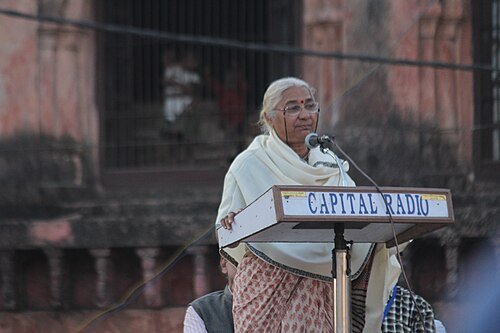
Social Activist · Founder, Narmada Bachao Andolan · Voice of India’s Forgotten Millions
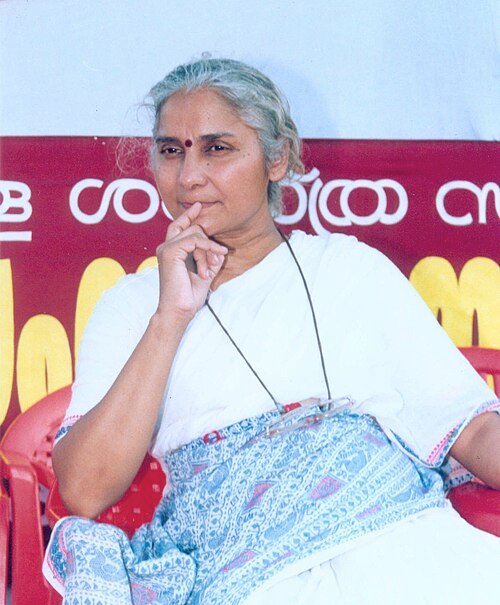
There is a photograph that India will never forget.
A woman, waist-deep in the waters of the Narmada River, refusing to move. The dam gates are open. The water is rising. Police officers stand at the banks, watching. Officials have warned her repeatedly. Journalists are calling it madness. And she — small, calm, unflinching in a white sari — simply stays.
That woman is Medha Patkar.
And she was not there for drama. She was there because behind her, invisible to most of India, were hundreds of thousands of tribal families who had been told to quietly disappear — to make way for a dam, for “progress,” for a version of India that had no room for them.
She refused to let them disappear without a fight.
And that refusal changed history.
Table of Contents
A Girl Raised on Justice
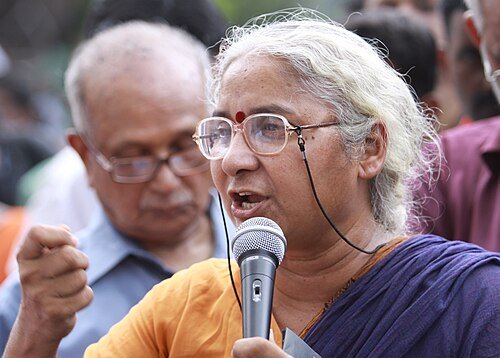
Medha Patkar was born on 1 December 1954, in Mumbai, into a family where social consciousness wasn’t a hobby — it was a way of life.
Her father, Vasant Khanolkar, was a freedom fighter and trade union leader. Her mother, Indu Khanolkar, ran a women’s organization called Swadhar. The dinner table conversations in the Khanolkar household were not about career packages or society weddings. They were about workers’ rights, independence, and the dignity of ordinary people.
Growing up in this environment, young Medha developed something that no school can teach and no textbook can give: an unshakeable belief that injustice must be confronted, not accepted.
She went on to complete her Bachelor of Science from Ruia College, Mumbai, and then earned a Master’s degree in Social Work from the Tata Institute of Social Sciences (TISS), one of India’s most respected institutions. She even began a PhD there, researching social inequality and social movements. It was during this research that she first travelled to the Narmada Valley.
She went as a researcher. She came back as a revolutionary.
The River That Called Her Away From Everything
In the mid-1980s, the Indian government was pursuing the Narmada Valley Development Project, a plan to build a series of massive dams across the Narmada River. The crown jewel of the project was the Sardar Sarovar Dam, backed by the World Bank, promising irrigation, electricity, and development across Gujarat, Madhya Pradesh, and Maharashtra.
What the official announcements quietly skipped over were the people.
When Medha Patkar arrived in the Narmada Valley to do her research, what she found shook her to the core. Over 250,000 people, mostly tribal communities, farmers, and forest-dwellers were facing displacement. Their villages, their ancestral lands, and their entire way of life were going to be submerged. And the government’s rehabilitation plan? Almost entirely on paper.
There were no proper resettlement sites. No compensation worthy of the name. No one who seemed to care.
Medha made a decision that would alter the course of her entire life. She left her PhD. She left her faculty position at TISS. She moved into the valley, lived among the people whose lives were at stake, and began the work of fighting back.
In 1986, she established the Narmada Dharangrastra Samiti, which in 1989 formally became the Narmada Bachao Andolan (NBA): Save the Narmada Movement.
She was 31 years old, armed with nothing but conviction and the truth.
What She Was Actually Fighting Against
Let us be honest about what Medha Patkar was up against, because the scale of it matters.
On one side: the Government of India, the governments of three states, the World Bank with billions of dollars in funding, powerful construction lobbies, and a mainstream narrative that framed anyone opposing the dam as being “anti-development” and “anti-national.”
On the other side: Medha Patkar, a handful of activists, and hundreds of thousands of displaced people with no political power and no media voice.
She wasn’t just fighting a dam. She was fighting a model of development that believed the poor must always pay the price of progress — that tribal communities are expendable, that a fishing family’s livelihood matters less than a city’s electricity supply, that justice is a luxury reserved for those with influence.
She stood up and said: No. Development that displaces the poor is not development at all.
The Hunger Strikes That Almost Killed Her
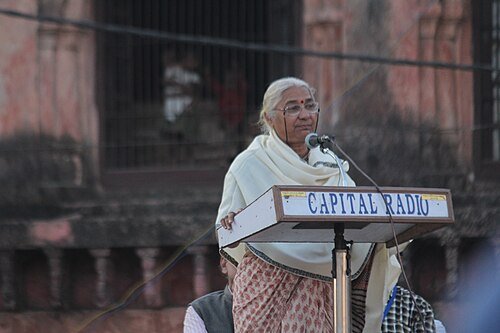
Medha’s methods were Gandhian — rooted in non-violence, truth, and peaceful resistance. But non-violence does not mean safe. It means choosing to absorb suffering rather than inflict it.
She led massive marches and rallies beginning in 1985. Though the protests were entirely peaceful, police repeatedly beat and arrested activists, including Medha herself. Demonstrators had their hands tied together to show their non-violence — and were still dragged away and dumped miles into the wilderness.
In 1991, during a confrontation at the Gujarat border, where NBA members and nearly 3,000 displaced villagers were stopped by police and counter-protesters bussed in by the government, Medha went on an indefinite hunger strike that lasted 22 days.
She nearly died.
Doctors warned her. Her supporters begged her to stop. The state watched and waited. But she continued, because she knew that the moment she got up from that fast without a resolution, the people she was fighting for would lose their only leverage.
She undertook multiple hunger strikes over the years, each one a physical reckoning with the question: How much are you willing to sacrifice for what you believe?
Her answer, every single time, was: Everything.
When the World Bank Blinked
The NBA’s greatest institutional victory came in 1993, when the World Bank withdrew its funding from the Sardar Sarovar project — a stunning and unprecedented outcome.
This was not luck. It was the result of years of painstaking campaigning: documenting the human cost of the dam, building international coalitions, filing public interest litigations, presenting evidence to global bodies, and above all, keeping the voices of displaced communities in the room when decisions were being made about their lives.
In May 1994, the NBA took the case to India’s Supreme Court. In January 1995, the Court put a stay on further construction of the half-built dam — another extraordinary moment in the history of people’s movements in India.
Medha Patkar had taken on the state and the world’s most powerful financial institution. And she had made them stop.
The Challenges That Tried to Break Her
If you think her path was a straight line from struggle to victory, let us tell you the harder part of the story.
The Narmada struggle was not one battle. It was decades of them.
State governments continued to push for increases in the dam’s height. The Supreme Court ultimately allowed construction to resume and the dam was eventually built, with water reaching farmers across four states. For Medha, this was not a simple win-or-lose story — it was an ongoing fight to ensure that every single displaced family received proper rehabilitation before submersion, a fight that continues to this day.
She was arrested multiple times, in 1985, 1991, 1996, and again in later years. Each arrest was a statement: we will silence you. Each time, she returned.
The road of an activist is rarely smooth, and Medha Patkar’s has been no exception. Over four decades of public life, she has faced institutional pushback, legal battles, and fierce opposition from those who disagreed with her methods or her message. There have been arrests, court appearances, and prolonged legal proceedings that would have exhausted most people into silence.
She has never been silent.
Through every setback, personal, legal, or political, she has shown up again. Not with bitterness, but with the same steady, purposeful energy she brought to the banks of the Narmada all those years ago. That quality, the ability to absorb adversity without being defined by it, may be her most underrated strength.
What She Built Beyond the River
Medha Patkar’s work has never been only about the Narmada.
In 1996, she co-founded the National Alliance of People’s Movements (NAPM), a coalition of activists and organisations working across India against displacement, caste discrimination, communalism, and economic injustice. Under the NAPM banner, she has supported struggles across the country for decades.
In 2005, she launched the Ghar Bachao Ghar Banao Andolan (Save Home, Build Home Movement) in Mumbai, when the Maharashtra government demolished over 75,000 homes, leaving thousands of the urban poor homeless overnight. Once again, she stood with those who had been made invisible.
She has worked on behalf of slum-dwellers, hawkers, unorganised sector workers, Dalit communities, and women facing economic and social injustice. She was a member of the World Commission on Dams, contributing to a landmark global report in 2000 on the social and environmental impact of large dam projects.
She has also worked to create residential and day schools in villages of Maharashtra, Madhya Pradesh, and Gujarat because she understands that education is inseparable from justice.
Her Awards and Recognition
The world has taken note of what India’s government has sometimes tried to silence.
- Right Livelihood Award (1991): often called the Alternative Nobel Prize, awarded by Sweden’s Right Livelihood Foundation.
- Goldman Environmental Prize (1992): one of the world’s most prestigious environmental honours.
- Amnesty International Human Rights Defender Award (1999)
- BBC Green Ribbon Award
- Judges in the defamation case noted she had received 28 national awards and 5 international awards in recognition of her life’s work.
- Most recently, in May 2026, she was awarded the Sukumar Azhikode Centenary Award, alongside noted author Perumal Murugan, an honour that recognises extraordinary intellectual and social contribution.
She has been recognised at MIT, presented at global forums, and celebrated by human rights organisations across continents. And yet, she has consistently chosen to spend her days not at podiums but in fields, villages, and protest sites because that is where the work is.
Still Standing at 71
At 71 years old, Medha Patkar is not resting.
She has never married, choosing instead to make the communities she serves her family. She lives modestly, often among the people she fights for. She continues to be involved in the Narmada struggle and the NAPM. She is still being arrested, still being awarded, still being called radical, and still showing up.
There is a quiet kind of power in a woman who has spent 40 years being told to stop and simply… hasn’t.
What We Can Learn from Medha Patkar
For every woman reading this who has a cause she cares about, a wrong she wants to right, a voice she has been told to lower — here is what Medha Patkar teaches us:
🔥 Purpose is not a destination. It is a direction. She did not start with a plan to win a battle against the World Bank. She started by moving towards injustice instead of away from it. The rest followed.
✊ Sacrifice is not suffering — it is proof. When Medha went on those hunger strikes, she was not being reckless. She was proving, in the most visible way possible, that she meant what she said. Sometimes the world only listens when you show it how much you are willing to give.
🌿 Your voice can move institutions. She was one woman from a middle-class Mumbai family with an MSW degree and no political backing. She took on a government, a World Bank project, and decades of entrenched power. And she made them move. Your voice, when backed by truth and sustained by commitment, is more powerful than any title.
❤️ Fighting for others is not separate from your own freedom — it is your freedom. Medha Patkar did not give up her life to serve others. She found her life in that service. There is a version of fulfilment that does not come from achievement for yourself, but from becoming indispensable to someone else’s survival.
🕯️ Being labelled “difficult” is not a problem. It is a sign you are doing something important. She has been called anti-national, anti-progress, a troublemaker. Every woman who has ever challenged an unjust system has been given a label. Wear it. Keep moving.
A Fire That Did Not Go Out
We live in a world that rewards compliance. That asks women to be pleasant, to not rock the boat, to accept the terms they are given.
Medha Patkar looked at that world and said, “I have other terms.”
She gave up a comfortable career. She gave up security. She stood waist-deep in rising water because the people behind her had nowhere else to go, and she had decided that their lives mattered as much as any project, any dam, any politician’s legacy.
At Work Well Womaniya, we celebrate women who remind us that ambition can be directed outward, toward justice, toward community, toward the world you want your daughters to inherit.
Medha Patkar is not just a woman of the week.
She is a woman of the century.
Craving more doses of inspiration? Here’s more:
Woman of the Week: Dr. Pritpal Kaur Batra
The Officer Who Chose People First
Woman of the Week: Varsha Deshpande
A Lifetime of Courage, A Legacy of Change
Woman of the Week: Laibi Phanjoubam
The Grandmother Who Turned Football into Freedom
References:
https://www.deccanherald.com/india/medha-patkar-not-allowed-meet-690652.html
https://www.britannica.com/biography/Medha-Patkar
thefamouspeople.com/profiles/medha-patkar