The Woman Who Stood on Top of the World — Five Times
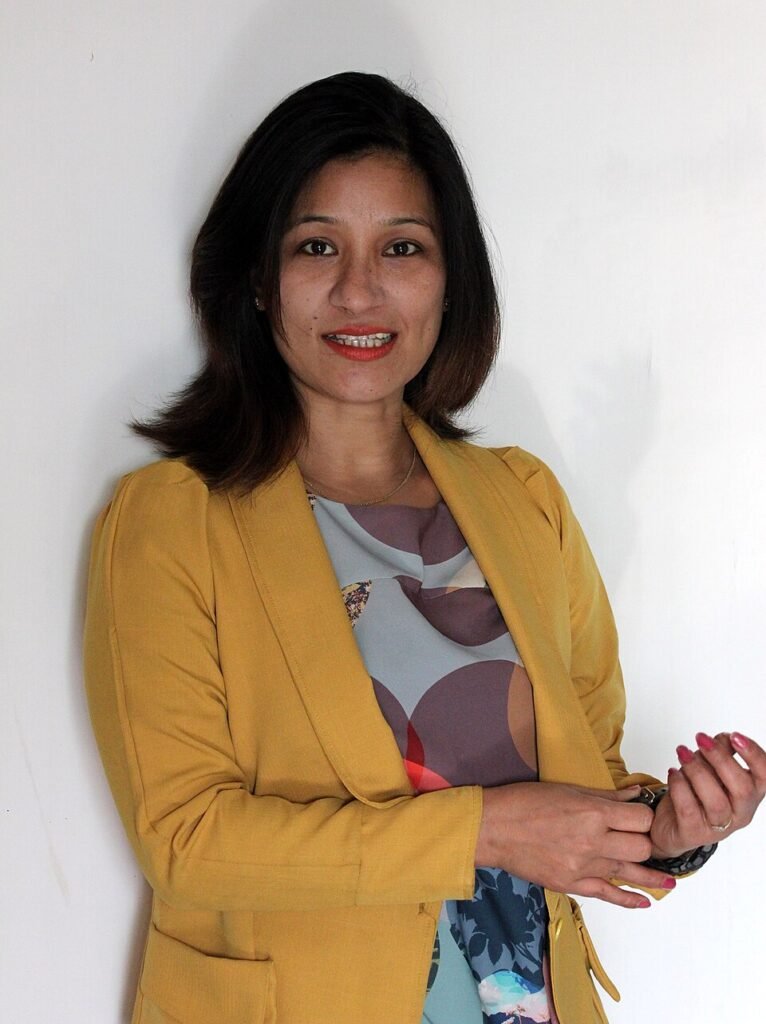
There is a small town in Arunachal Pradesh called Bomdila, tucked into the foothills of the eastern Himalayas, where the air is clean and the mountains feel close enough to touch. It is here that Dr. Anshu Jamsenpa was born, raised, married, and became a mother of two. It is also where she made a decision, in her late twenties, that would place her name in the Guinness World Records and eventually earn her India’s Padma Shri.
She did not grow up dreaming of Everest. She grew up dreaming of becoming a journalist. But life, as it so does for women, took a different shape: marriage at 21, two daughters, a husband’s travel business to help run, an office to sit in day after day. And then, one afternoon, a trekking client watched her rappel down a cliff face without a moment’s hesitation and said something that changed everything: ‘You have the courage, and your fitness is very good. Why don’t you go for a professional mountaineering course?”
She went. And she never looked back.
Get inspired by more women achievement stories
Table of Contents
What She Has Achieved
Dr. Anshu Jamsenpa is the first woman in the world to scale the summit of Mount Everest twice in a single climbing season, and the fastest woman to complete a double summit and doing so within just five days.
Let that settle for a moment. Not once. Not twice over a career. Twice in five days. At 8,849 metres above sea level, where every breath is a negotiation and the temperature drops to –40°C, she went up, came down, rested briefly, and went straight back up again.
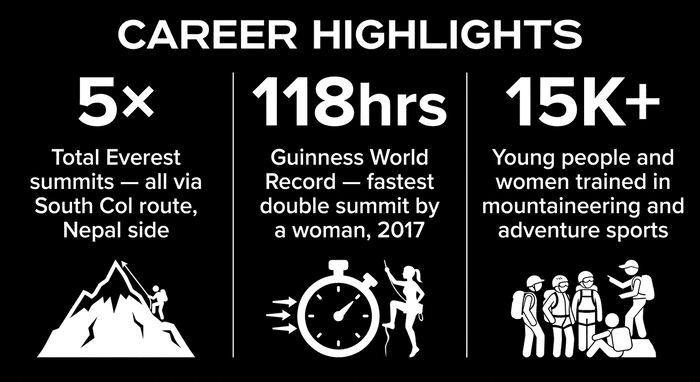
In 2011, she became the first woman in the world to summit Mount Everest twice within a single climbing season, achieving the double ascent on May 12 and May 21, ten days apart. She returned in 2013 for her third summit. Then in 2017, she did something no woman had ever done: she repeated the feat with ascents on May 16 and May 21, marking the fastest double summit by a woman at that time, completed in just five days, approximately 118 hours, an accomplishment recognised by Guinness World Records.
Her 2017 double ascent made her the first Indian woman to summit Mount Everest five times in total, with successful climbs in 2011 (twice), 2013, and 2017 (twice), all via the South Col route from Nepal.
Before she set out on that record-breaking 2017 expedition, she sought and received the personal blessing of the 14th Dalai Lama in Guwahati, a moment she has called “the most beautiful of my whole life.” On May 16, she stood at the summit and unfurled the Indian tricolour. Three days later, she began climbing again. On May 21, she was back at the top. Prime Minister Narendra Modi tweeted his pride. The world took notice.
When asked what it feels like to stand at the roof of the world, she does not reach for athletic language. She reaches for something quieter and truer: “Standing there, I felt I was close to God who was watching me.”
The Padma Shri, And What It Means
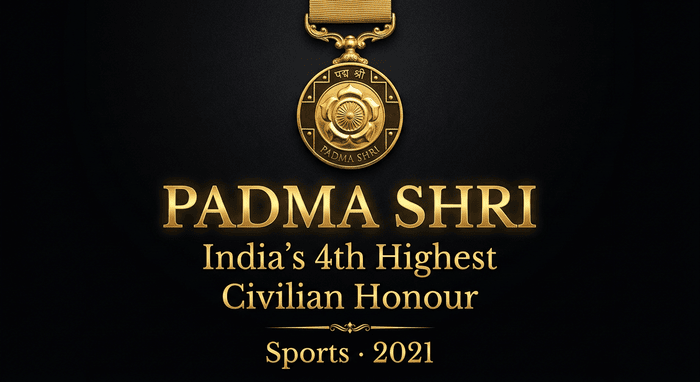
On Republic Day 2021, the Government of India announced that Dr. Anshu Jamsenpa had been conferred the Padma Shri, India’s fourth-highest civilian honour, for her accomplishments as a mountaineer.
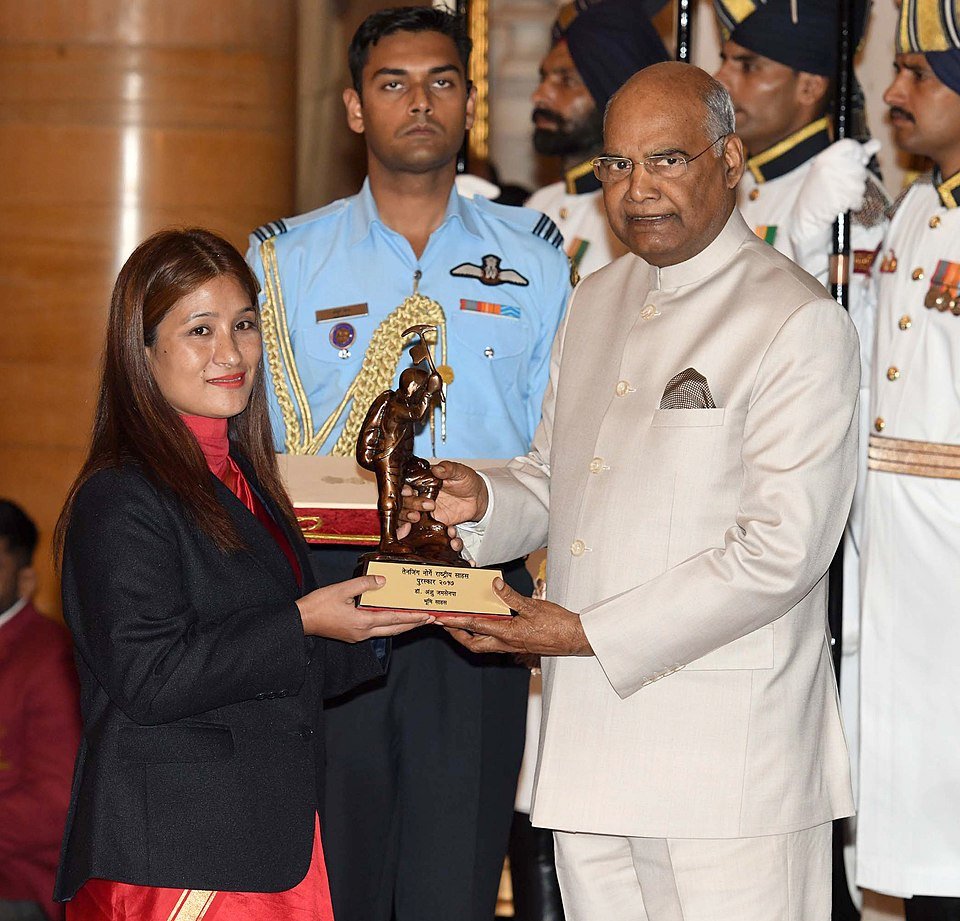
President Ram Nath Kovind presented the award at Rashtrapati Bhavan. The official citation noted that she holds two world records: the fastest woman mountaineer to summit Mount Everest twice in five days, and the first woman mountaineer to achieve double ascents of Everest.
With this, she joined the illustrious list of women mountaineers like Bachendri Pal, Santosh Yadav, Premlata Aggarwal, and Arunima Sinha to have been conferred Padma awards. These are the names Indian schoolchildren learn. Anshu Jamsenpa now belongs in that company, not as a footnote, but as a full chapter.
This was not her first national recognition. In 2018, President Kovind presented her the Tenzing Norgay National Adventure Award 2017, India’s highest adventure honour, at Rashtrapati Bhavan. She was also conferred a PhD by Arunachal University of Studies for her achievements in the field of adventure sports. She has been Brand Ambassador for Swachh Bharat Abhiyan and for North East Tourism. The CNN-IBN Young Indian Leader Award, the FICCI Woman Achiever of the Year, the Tourism Icon of the Year from the Arunachal Pradesh government, the recognitions have been many.
But when the Padma Shri was announced, her response cut through all the noise. She did not celebrate with fanfare. She said simply: “Awards energise sportspersons to excel, but Padma Shri means Responsibility.”
That single sentence tells you everything about who she is.
“Standing there, I felt I was close to God who was watching me.”— Dr. Anshu Jamsenpa, on reaching the summit of Everest
The Challenges She Faced
Here is where the story gets even more remarkable because none of this was handed to her. Not the opportunity, not the funding, not the social permission, not the family support (at least not at first), and certainly not the mountain.
She started late, with no roadmap. Most elite mountaineers begin young, with coaching, institutional support, and a community around them. Anshu began in her late twenties, after marriage and two children, in a field where no woman from her community had gone before. Her mountaineering journey began in 2009 when trainers at the Arunachal Mountaineering and Adventure Sports Association encouraged her to take up the sport. Before that, she had no idea mountaineering was even a possibility for her. She had to invent her own path from scratch.
She faced serious financial hardship. High-altitude mountaineering is extraordinarily expensive: permits, Sherpa support, equipment, and multi-week acclimatisation camps cost lakhs. She has spoken openly about the financial challenges she faced:
Financial challenges were a major hurdle. My children were small, and there were moments when nobody believed in me. I had to endure mental, emotional, and financial struggles. Doubts and hardships tested my determination, but I never gave up.
She carried the weight of being a mother every step of the way. She is the mother of two daughters, Pasang Droma and Tenzin Nyiddon. Every expedition meant leaving them behind, holding the knowledge that she might not return. She has said:
“My first and foremost responsibility is towards my children. My dreams and passion come after them. My children are my top priorities.”
And yet she also knew, clearly, deliberately, that staying home would teach her daughters the wrong lesson. She told them openly: if something happened to her on the mountain, they should be happy, because she had lived fully.
She climbed in the face of constant doubt. The fact that she was a woman, and a mother, was routinely used as evidence that she should stop. She faced scepticism and a lack of support as she pursued her passion. The mountaineering world was, and largely remains, a male-dominated space. Questions that no male climber is ever asked were directed at her constantly. She answered every single one of them with her boots on the mountain.
And then there was the mountain itself. On her very first Everest summit in 2011, conditions turned violent near the top. Most climbers retreated. Anshu pressed forward through near-zero visibility with her Sherpa until she heard from behind her: “We’ve reached the summit.” She had not even known she was there. The mountain had demanded everything she had, and she had given it.
Get inspired by more women champions:
How She Overcame It All
She overcame it the way she climbs: one deliberate step at a time, without drama, without waiting for the conditions to be perfect.
The training was brutal and she embraced it. The drill was gruelling, from 4:00 am to 9:30 pm, and there was no time to even sit and talk. But she learnt a lot. Then came the advanced 28-day course in Uttarkashi. She did not cut corners. She did not look for shortcuts. She built herself into someone who could survive, and conquer, the world’s highest peak.
On April 2, 2017, she started her Everest climb from Guwahati after receiving the blessings of the 14th Dalai Lama. It took her 38 days to acclimatise at the 17,600 ft Everest Base Camp before she began her main journey. Patience was part of the discipline.
Her family became her foundation. The most significant pillars of her strength were her husband Tsering Wange and her children. She has said: “I have been very fortunate to have had two very understanding and mature daughters who eventually began to understand their mother’s passion to do something different. I feel very proud of them for motivating me.”
And when she came down from the mountain, she did not rest on what she had built. She turned it outward. Today she is a mountaineer, adventure trainer, and motivational speaker, and has already trained more than 15,000 youths and women in mountaineering and adventure sports. Her vision is clear: “By equipping youths with the right skills, discipline, and confidence, I want to create a new generation of explorers and leaders who will bring global recognition to our state.”
The summit was never only about herself. It never is, with women like her.
Why Her Story Is an Inspiration for Every Woman
Dr. Anshu Jamsenpa did not begin from a position of privilege or ease. She began from exactly where millions of Indian women begin, in a small town, with family responsibilities, with limited resources, in a field that had not been built for her, and with a world of people ready to tell her it was not for her either.
She started anyway.
And that is precisely why her story belongs to all of us, not just to mountaineers, not just to athletes, not just to women in Arunachal Pradesh. It belongs to every woman who has ever wondered whether it is too late to begin, whether her responsibilities are too many, whether anyone will believe in her, whether she has what it takes.
Anshu’s answer to all of those questions is written across five Everest summits, a Guinness World Record, and a Padma Shri.
Here is what her life teaches:
You do not need a perfect starting point. She found her calling in her late twenties, after marriage and children, with no precedent and no blueprint. She became a world record holder anyway. The clock does not run out on a woman who decides to begin.
Your responsibilities are not your ceiling. She is, before everything else, a mother. She chose to show her daughters, through action, not words, what a woman can build when she refuses to be defined by other people’s limits. That is the best thing she could have given them.
Support can be built, not just found. She did not wait for permission. She earned it, conversation by conversation, summit by summit, until her family and her community came to understand what she was building.
Pain is not a signal to stop, it is part of the road. She said it herself, after her 2017 world record: “I got blisters on my legs. I was tired, but I thought, ‘No, I must try. I must push.’ I had that confidence in me. If you try, you can definitely get success.”
When you reach the top, pull someone up with you. She has trained over 15,000 young people and women. She is planning a dedicated institute. The record she set is not a finish line. It is a launchpad for everyone who comes after her.
Her message to women is direct and unambiguous: “A perfect woman is not defined by society’s expectations but by her own strength, wisdom, and determination. To all women, embrace your uniqueness, nurture your dreams, and never let anyone limit your potential.”
From a small town in Arunachal Pradesh to the roof of the world, five times, Dr. Anshu Jamsenpa has shown us that the mountains we are most afraid to climb are almost never the ones made of rock and ice. They are the ones inside our own heads. And she has shown us, beyond any doubt, that those can be climbed too.
Dr. Anshu Jamsenpa is a Padma Shri awardee, Guinness World Record holder, five-time Everest summiteer, Tenzing Norgay National Adventure Award recipient, and mountaineering trainer to over 15,000 young people across India. She is based in Bomdila, West Kameng district, Arunachal Pradesh.