
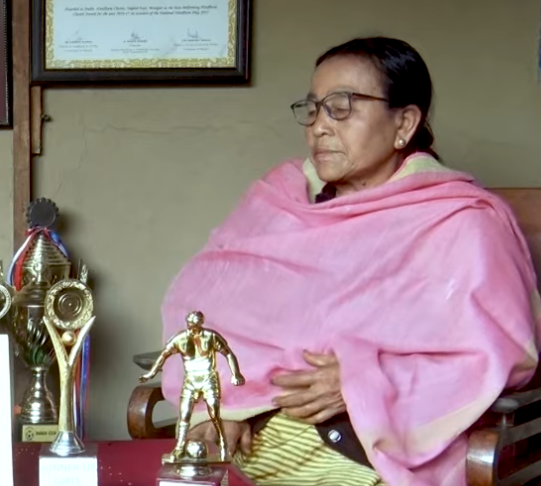
In Andro, a small village about an hour from Imphal in Manipur, they call her Ebo Grandmother.
She stands barely four feet tall. She owns no stadium, no fleet of buses, and no institutional funding. Yet for more than three decades, she has shaped the trajectory of women’s football in her region and protected an entire generation of girls from disappearing into violence, poverty, and early marriage.
Her name is Laibi Phanjoubam. She is the founder of AMMA FC: the Andro Mahila Mandal Association Football Club, and she is our Woman of the Week.
Table of Contents
The Girl Who Was Once Overlooked
Laibi Phanjoubam’s story begins in a society where daughters were often an afterthought. She was the fourth girl child in her family, frequently disregarded in a system that prioritised sons.
But she refused to accept invisibility as destiny.
She became the first woman in her village to complete her matriculation. That achievement alone was a rebellion. She went on to become a primary school teacher, carving out a life of dignity and independence.
Alongside teaching, she established handloom and weaving units in Andro. The rhythmic sound of the loom became part of her identity. Weaving was self-reliance for her.
What she did not yet know was that this loom would one day finance a football revolution.
A Club Born in the Shadow of Insurgency
The early 1990s were turbulent years in Manipur. Andro, like many places, felt the impact of insurgency and political unrest. Young people were vulnerable. Opportunities were scarce. Girls from the Loi Scheduled Caste community were especially at risk of being left behind, or worse, pulled into cycles of violence and early marriage.
Laibi Phanjoubam watched this unfold around her.
She had no background in sports administration. She had never managed a football team. But she understood one thing clearly: if girls had a purpose, they would have protection.
In 1993, she founded AMMA FC.
There was no funding proposal. No sponsorship deck. No institutional backing. But she had conviction.
She believed that if girls had a field to run on, they would not run toward despair.
Building Without Resources
AMMA FC began with almost nothing.
Practices were held on a simple village field. There were no floodlights, no gym facilities, and no transport buses. The girls practised at dawn and again in the evening before heading to school.
Laibi funded the club through her weaving. She sold traditional phaneks and shawls. When that income fell short, she found other ways to sustain the team. Every rupee she earned circled back to the girls for jerseys, football kits, travel, and sometimes even food.
She never drew a salary.
Her home doubled as a workspace and a community hub. Her bicycle became her vehicle of leadership. She cycled across Andro, checking on players, persuading parents, and ensuring girls stayed committed.
She was not just a coach. She was a guardian, negotiator, fundraiser, and mentor.
The Impact Measured in Lives
Over the past 30 years, AMMA FC has trained more than 150 girls who have gone on to represent at the state, national, and even international levels.
One of the most visible examples is Nirmala Phanjoubam, who rose to become part of the Indian women’s football team. Ahead of an international friendly match, Nirmala publicly thanked “grandmother Laibi” for supporting her and other girls in pursuing the sport.
That gratitude reflects something more than athletic training.
It reflects protection.
Laibi has said that her efforts prevented many young women from drifting toward militancy during Andro’s most difficult years. Football became an alternative path: structured, disciplined, and hopeful.
AMMA FC also evolved beyond sport. Girls learned computer literacy. They learned weaving. They learned to see themselves as capable contributors to their community.
It was empowerment layered with practicality.
The Challenge of Retention
If building the club was difficult, sustaining it was even harder.
In conservative environments, teenage girls face pressure to marry early or withdraw from extracurricular activities most of the time. Laibi’s work also involves difficult conversations with families. She persuades parents to let their daughters continue playing. She frames football not as rebellion but as opportunity.
She argues that sport can be affordable. That it can open doors. It can lift families out of poverty.
Her persistence has kept many girls from vanishing into silence.
Even today, at 65, Laibi Phanjoubam continues her routine with discipline. She rises early, tends to household chores, works on her loom, and remains actively involved with the club she founded more than three decades ago.
From Village Secret to National Screen
For many years, her work remained largely unknown outside Andro. That changed when National Award-winning filmmaker Meena Longjam discovered her story through a newspaper clipping.
What followed was the documentary Andro Dreams, which premiered at the International Film Festival of India under the Indian Panorama section.
The film brought national attention to Laibi’s life: her weaving, her coaching, her quiet resistance against patriarchy, and economic hardship.
For the first time, the country saw what Andro had always known.
Yet even with recognition, financial support remains limited. AMMA FC continues to rely largely on her grit and small networks of support.
Why Laibi Phanjoubam Matters
Laibi’s story is not dramatic in the conventional sense. There are no grand speeches and no viral campaigns.
There is only consistency.
She demonstrates that empowerment does not always arrive through policy. Sometimes it begins with one woman deciding that girls in her village deserve more.
She did not wait for permission. and applause. Lack of resources didn’t become an excuse for her.
Instead, she built an ecosystem from scratch.
Laibi’s work and contributions reminds us that some of the most transformative leaders work quietly, far from headlines.
She turned football into a shield. She turned a handloom into funding. She turned a vulnerable generation into confident athletes.
And she did it while being called simply grandmother.
At WorkWellWomaniya, we celebrate women who not only succeed individually but also expand possibilities for others.
Laibi Phanjoubam is one such woman.
Her field may be modest, but the futures she has shaped are limitless.
Need more inspirations. Here are some amazing women stories for you: